
Look across the landscape of modern governance, commerce, and international relations, and a clear pattern emerges. Our global systems are trapped in a rigid loop of post-industrial realism. Born from the legacy of the factory floor and top-down command structures, society has conditioned leaders to look at positions of power as prizes to be won by any means necessary. Leadership is too often reduced to a relentless struggle for the “seat”—the chairperson’s gavel, the executive suite, or the prime minister’s desk.
This fixation on dominance reveals the core problem of the world today: we have decoupled position from contribution. Humans rely on political maneuvering and resource hoarding to force themselves into authority rather than providing real, organic value to society. True statesmanship requires a structural pivot. A leader’s legitimate authority is derived entirely from the net value they return to the human ecosystem, never from their ability to compel compliance.
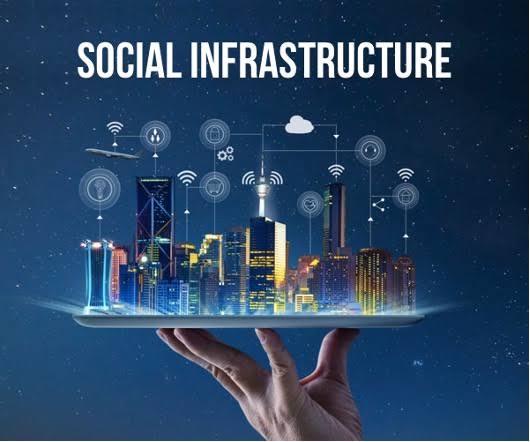
When leadership is measured by value creation, infrastructure becomes the definitive proof of that contribution. True leaders build the foundational scaffolding that allows a society to prosper. This value is delivered across four distinct planes:
- Physical Infrastructure: Tangible public assets such as libraries, schools, parks, playgrounds, and healthcare systems.
- Financial Infrastructure: Capital investments, public-private partnerships (PPPs), and developmental frameworks that fund civic progress.
- Digital Infrastructure: E-governance platforms, secure data exchange grids, and public service networks that bridge technological gaps.
- Social Infrastructure: The invisible networks, relational trust, institutional health, and community values that serve as the human glue of society.
The Geopolitical Planes of Power and Soft Power Projection
When a nation optimizes its internal infrastructure, it naturally generates soft power—the capacity to engage and influence foreign publics through attraction rather than coercion. Today, modern public diplomacy increasingly intersects with infrastructure. For instance, when a government shares its Digital Public Infrastructure (DPI)—like scalable electronic payment grids or identity systems—it creates a practical tool for technological cooperation that builds lasting international trust.
However, different cultures view and project influence through completely distinct lenses.
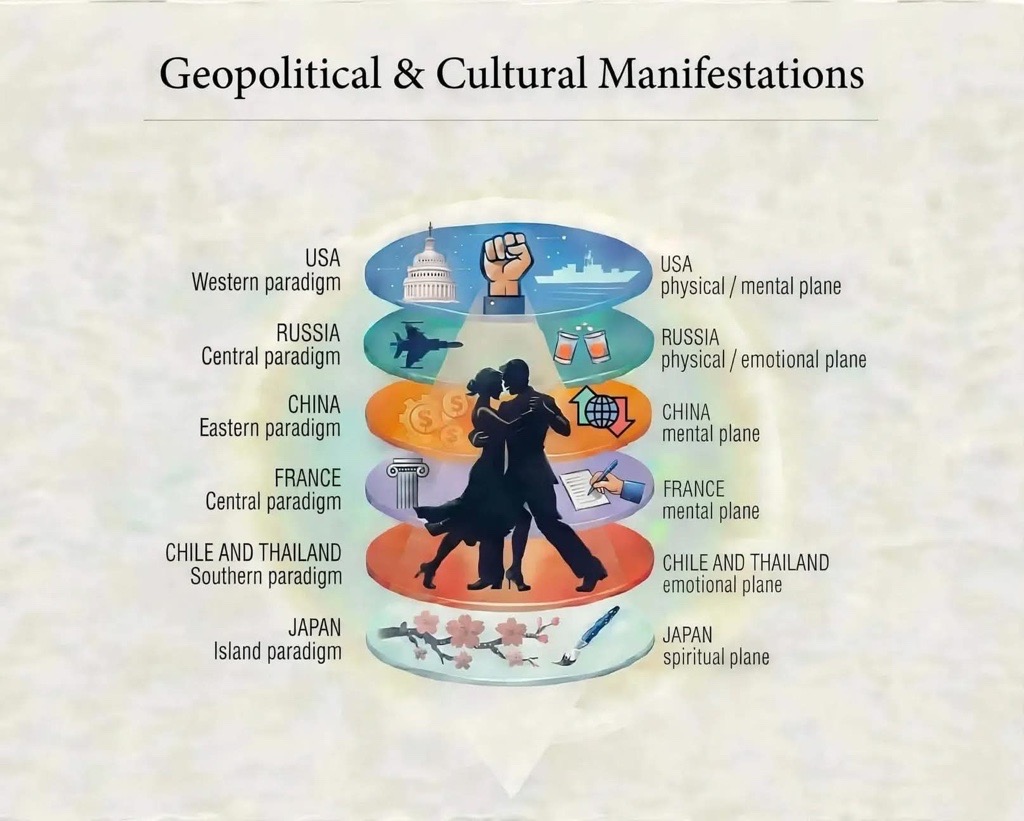
- United States (Western Paradigm): Controls through a blend of physical military might and formal institutional structures. Operating on a physical and mental plane.
- Russia (Central Paradigm): Focuses on physical power projection derived from military capacity, supported by relations. Operating on a physical and emotional plane.
- China (Eastern Paradigm): Projects financial power rooted in global commerce, trade networks, and socioeconomic rankings. Operating on a mental plane.
- France (Central Paradigm): Leverages institutional and paper-based frameworks. Projecting mental influence through sprawling international cultural networks.
- Chile and Thailand (Southern Paradigm): Generate deep social influence through authentic personal connections. Operating primarily on an emotional plane.
- Japan (Island Paradigm): Elicits core global attraction through aesthetics and quiet, longterm socioeconomic investments. Anchoring its influence on a spiritual plane.
Understanding these paradigms allows leaders to design highly innovative public diplomacy initiatives. Expensive, traditional cultural hubs like the British Council or Alliance Française are no longer the only path. Modern soft power is highly pragmatic. Consider Indonesia, which has established a formal program to send its youth to work and train alongside aging populations in Japan—a symbiotic framework that solves structural problems for both societies. Similarly, Mexico emphasizes immersive residential hosting and community-level homestays to build deep, emotionally grounded loyalty with international visitors.
Overcoming the Tech-Driven ‘Cognitive Hostage’
In our current post-industrial landscape, the venues for public diplomacy and connection have rapidly migrated online. While digital networks scale efficiently, they introduce a critical vulnerability: the state of becoming a cognitive hostage.
As attention is commercialized into raw capital, individuals routinely surrender their independent vision and critical thinking to centralized corporate algorithms. We blindly follow the bouncing ball of online trends on our screens, losing our connection to real-world spaces and communities. The rapid integration of artificial intelligence within digital infrastructure risks automating this isolation, turning human cognition into an asset managed by distant networks.
This digital insulation often breeds a fragile culture of appeasement—a system that rewards aggressive, power-seeking behavior while forcing authentic victims to bow to structural weight. To counter this, adaptive leaders must look beneath surface dynamics and accurately map power relationships by evaluating who controls a resource, who depends on it, and what alternative can shift the balance away from dominance and toward cooperation.
Inside-Out Leadership: The Receptive Core
To transition from an “eggshell” style of leadership—where a leader simply memorizes a checklist of superficial metrics to preserve an illusion of control—we must focus on The Core. Traditional policy analysis stops at three dimensions: Place (the physical space), Institutions (the organizational pillars), and Connections (the social networks). The missing variable is always the individual human spirit.
True leadership value operates from the inside out, requiring a profound mastery of the energy of receptivity. Raw information and absolute truth are completely ineffective if the receiving heart is closed. As preserved in the ancient wisdom of the Shaolin tradition, if you speak true words at a moment when the other person’s internal energy field is in a closed mode, that truth will fail to reach them.
It does not matter how flawless your arguments or how accurate your data points are; if the energy field is shut down, you are speaking to a wall. Receptive leaders train themselves to hear the “song beneath the notes”—reading the subtle, underlying energy field of a public or an organization before attempting to project influence.
Conclusion: The Ultimate Metric
International relations and community leadership share the exact same final resolution: Value is the ultimate metric for measuring leadership. Global authority does not belong to the entity that commands the most coercive force or the most aggressive commercial dominance. True leadership belongs to whoever possesses the vision, the humility, and the systemic capacity to bring a fragmented world together by providing a high-value, open network of human cohesion.
This article was AI assisted.