
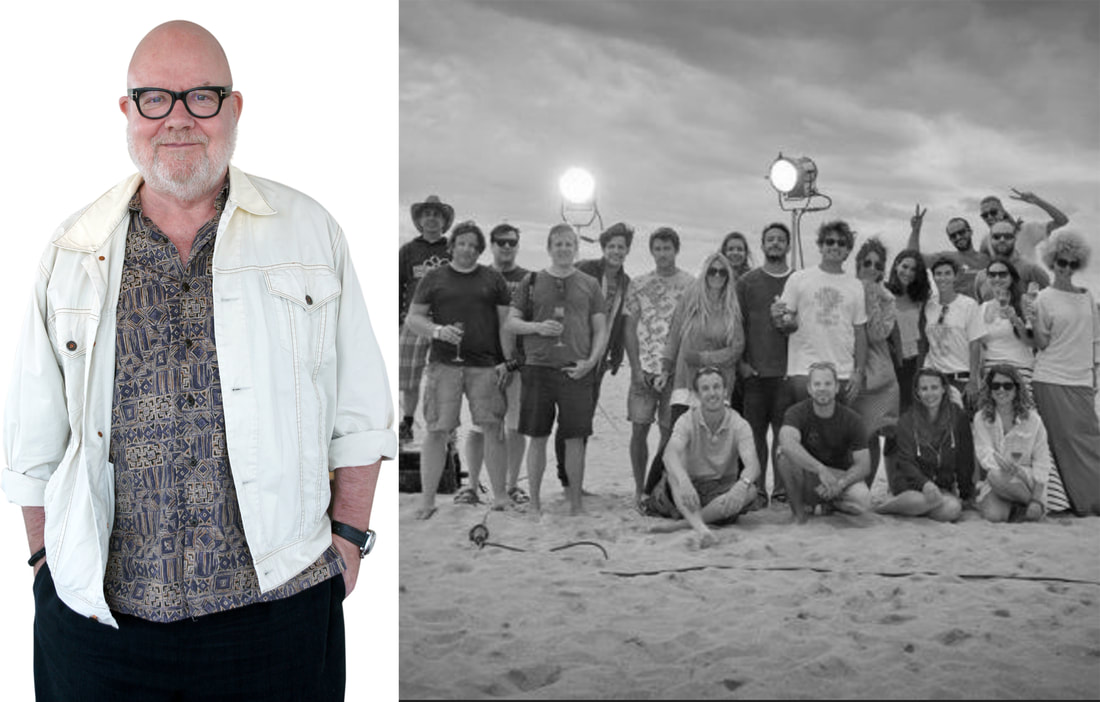
A feature story on a life spanning continents, careers, and decades — by Maxmilian Wechsler, Numeni Contributor
Swedish filmmaker Ola Lennart Holmgren took to the road right out of high school in the early 70s and began working his way around Europe in the travel industry. On the way he met Grete, the Norwegian girl he married and took back to Sweden in 1976. Ola had no training or experience in film production, but after deciding that’s what he wanted to do, he was unshakeable in his goal.
With a period of apprenticeship, a little luck and a lot of hard work he made his dream come true: he launched a couple of big-time production companies that attracted top talent in the industry. And he won around 100 awards while compiling a remarkable portfolio of celluloid and digital creations that includes feature films, television series and hundreds of TV commercials.Second paragraph continues the narrative — early life, career beginnings, or the pivotal moment that set everything in motion.
Along with the success and acclaim, Ola’s decision to follow his calling in film also set him on a course for adventure and lots of travel, and through it all Grete has been by his side. In 2008 the couple came to Thailand to retire, but not surprisingly they continue to keep very active. They frequently go on trips around Thailand and Asia with the Siam Society and pursue a variety of interests in the local community.

Background
“After I finished high school in Sweden in 1971, I left the country. I was just 18 years old, but my parents allowed me to go abroad. I wanted to see other countries so I took a job with the Swedish travel agency Club 33, and got a job as a DJ in Romania. Nobody else wanted to go there, and to be honest I didn’t like it too much either, but it was my introduction to travel.
“After a while I left the DJ job and worked as a tour guide in Rhodes, Greece, and later Gran Canaria and Ibiza in Spain. That’s where I met Grete. She was working in Ibiza as a tour guide as well. She was looking after older people and I was looking after young people. We tried to mix our activities so we could be together, but this didn’t work out so well.
“In the travel business especially at that time – you have to fix any problems that come up. For instance, if there are clients coming and you don’t have enough hotel rooms for them, you have to find the rooms one way or another.
“Four and a half years after we met, in 1976, Grete and I were married. She wanted to go to Sweden because she found a job with ScandinavianAirlines, and of course I followed her. I did my very delayed, one-year mandatory military service, and after that I started trying everything to get in the film business. When you are very young and naïve you think that you can do whatever you want, and in a way this is good because then you learn that there are more opportunities than there are problems. This has been my motivation.
“To be honest, when I decided to be a filmmaker I didn’t even know what that meant or what I needed to know. I had a high school education and my grades were very mediocre. I started taking day and evening courses in marketing, economy, design and advertising.
“One day in 1977 one of my teachers who knew my ambition to be a film producer said to me: ‘I know you are looking for job and I know that Sandell Film (a large corporate film production company) are looking for a young, hard-working junior assistant who won’t ask for too much money.’ This was me. The teacher arranged a meeting with the company owner, who was a famous, old school producer who mainly did films for big companies.
“The owner told me I would be on a three-month trial period without pay, and if I was good enough I could stay on. Then he said I would start the next day, which was fine with me. Finally, he told me: ‘You will meet a very important client, but you are not allowed to talk, just sit there and if someone ask you something, don’t answer. Just say hmmm…’ I thought this was all a bit strange, but I realized he had low expectations for me and probably thought the less I did the better. The last thing the owner told me was not to dress up in a jacket and tie because ‘the people you will meet won’t like it’.
“I stayed with the company for about a year and a half and tried to learn as much as possible. In 1979 some colleagues and I opened a small production company called Film & Video AB. We wanted to produce our own commercials for TV. At that time Sweden was probably one of a few countries in the world that didn’t have commercial television. There were absolutely zero commercials on TV, but everybody was saying and thinking they were going to come soon.
“The company was doing well, working on various productions, but we only lasted about two years. Everyone had different personalities and ideas, and we split in 1980. I started a new company, Mekano Film & Television AB. This time I tried to find people who had similar ideas as mine. I also learned a big lesson: If you don’t have enough money to finance your business, you need to have a friendly relationship with the banking industry. I tried to borrow money from several banks with no luck before one lent me the money with the condition that if I couldn’t pay the interest the bank was entitled to claim everything I had. I agreed.
“It was perfect timing. The same month I got the loan Sweden finally decided to allow TV advertising. Two new commercial TV stations opened. In a small country like Sweden with just 10 million people, this was very big. We were the first ones set up to take advantage of this big change. We had no competitors, but it wasn’t long before everyone wanted to do commercials for television.
“We grew fast, from 14 to 45 and then 50 employees. It was a fun time and it was hard work. I was using knowledge gained at other companies, like you have to take good care of your staff because this is really your only capital. You have to motivate and treat people well so they feel happy and see a good future in the company. We spent a lot of money training the staff and even sent them abroad.
“Later on we started to produce TV programs, including feature films. It was a good time, but extremely hard work. When you are young it doesn’t matter, but today I wouldn’t do it. At that time I looked at it all as a challenge. We managed to make a lot of money and even bought a little island for all the staff. Grete was still working for Scandinavian Airlines, but at the same time she was doing a great deal to support our company.
“I sold the company in 1988 to a big publishing firm. When I discussed their offer with my wife she said I should sell because I was always working and she never saw me. She urged me to take all the money they were offering and do something else. Many of the people who used to work for me are now famous directors, producers and actors. Some are working in Hollywood, New York or London.
Originally featured on The Big Chilli. Republished with permission on Numeni.