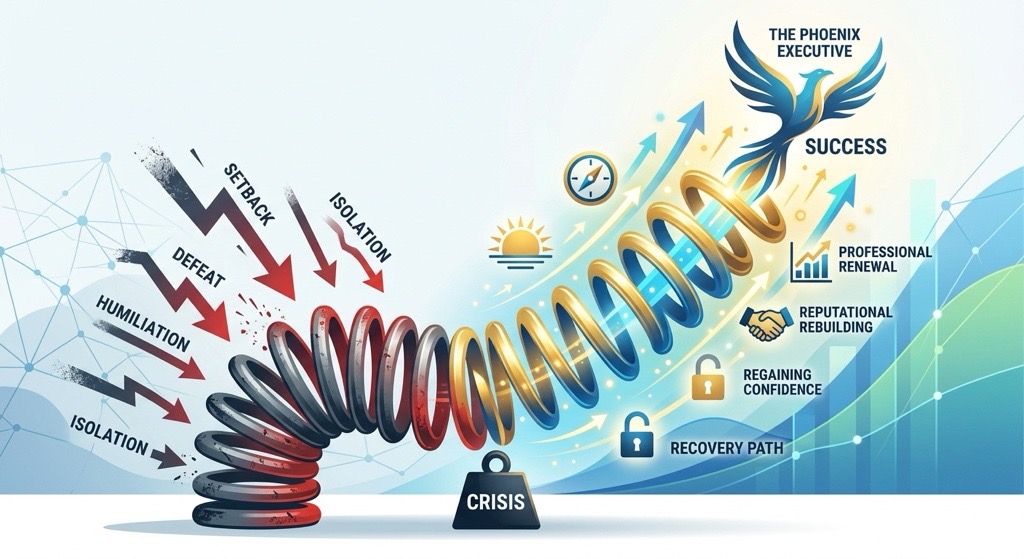
In the modern landscapes of global commerce and political governance, the primary metric of leadership longevity is shifting. For decades, the dominant corporate narrative held that technical expertise, strategic foresight, and raw execution skills were the absolute guarantors of a permanent seat at the table. However, contemporary research across behavioral science and organizational psychology points to a different reality: long-term leadership survival is fundamentally determined not by how an executive maintains power, but by how they recover when they lose it.
Every high-profile career experiences tectonic disruptions—be it a forced boardroom ouster, a public policy defeat, an institutional scandal, or a catastrophic financial restructuring. When these crises strike, the fallout is rarely confined to a balance sheet or an electoral tally. Instead, the loss triggers a complex cascade of psychological trauma, behavioral erosion, and structural isolation. To build a truly sustainable career, an executive must move past conventional technical management and actively learn the science of personal, psychological, and systemic recovery.
The Invisible Architecture of Defeat
A significant professional setback damages an executive’s internal identity far more than their objective skill set. When a leader faces sudden public humiliation or professional rejection, the brain processes the experience through a deeply biological distress mechanism. Clinical literature highlights that the initial phase of leadership defeat is routinely characterized by acute psychological and physiological symptoms:
- The Emotional Spiral: Leaders frequently cycle through acute periods of clinical depression, profound anger, and a complete destabilization of self-confidence. The ego, heavily fused with institutional titles and systemic authority, suffers immediate fragmentation.
- Maladaptive Malignancy: Under the immense cognitive load of failure, executives are highly susceptible to developing unhealthy coping habits. This often manifests as severe sleep deprivation, substance reliance, chemical dependencies, or toxic behavioral isolation.
- The Network Vacuum: Simultaneously, a collapsing reputation triggers an immediate erosion of social networks. The “echo chamber” of superficial corporate allies evaporates, leaving the executive trapped in a sudden, punishing isolation exactly when structural support is most critically required.
Unmanaged, this combination of internal shame and external abandonment forces a permanent downward trajectory, turning a temporary operational setback into a definitive career termination.
The Strategic Steps to Executive Recovery
Bouncing back requires a structured, multi-dimensional framework designed to repair both the leader’s internal psychology and their external credibility. Grounded in institutional research, notably the landmark recovery frameworks pioneered by scholars Jeffrey Sonnenfeld and Andrew Ward in the Harvard Business Review and their foundational text Firing Back, the anatomy of a successful executive rebound follows a deliberate trajectory:
1. Emotional Detox and Energy Management
The instinct of many aggressive leaders is to instantly launch a counter-offensive or race into a new venture. Organizational psychologists warn that this is a severe decision-making trap fueled by emotional overreaction. As noted in the Harvard Business Review, true resilience is not about your capacity to endure suffering; it is entirely about how effectively you recharge.
Before executing a professional pivot, a leader must implement strict energy management systems. This includes complete psychological detachment from the failure site, treating recovery as a non-negotiable professional mandate, and systematically correcting the physical anomalies—such as irregular sleep, poor nutrition, and high cortisol levels—caused by prolonged crisis stress.
2. Radical Accountability and the “Fight, Not Flight” Mindset
To rebuild a damaged reputation, an executive must actively run toward the center of the adversity rather than fleeing into obscurity. However, this confrontation cannot be defensive. Harvard Business School Professor Amy Edmondson emphasizes that thriving after failure requires absolute, transparent accountability.
Edmondson’s Core Matrix for “Failing Well”
Owning the narrative prevents adversaries from defining the failure for the public record.
3. Controlled Network Re-Engagement
Defeat decimates superficial professional networks, leaving a trusted core intact. Recovery relies on a highly calculated, paced reconnection strategy. Leaders must first engage a small, highly secure inner circle of trusted peers and mentors to obtain unvarnished, psychologically safe feedback.
Once emotional clarity is established—typically within a target window of two to four weeks—the executive can progressively expand their outreach to the broader market. This outward expansion must focus strictly on objective information-gathering, identifying industry shifts, and uncovering alternative strategic avenues.
4. Proving Mettle and Reputational Reconstruction
The final phase of institutional recovery involves demonstrating renewed operational competence. Trust is a lagging economic indicator; it returns only through consistent, verifiable performance over time.
Executives must actively seek out smaller-scale advisory positions, interim consulting turnarounds, board placements, or specialized non-profit governance roles. Delivering high-value execution within these alternative ecosystems provides undeniable proof to external stakeholders that the leader’s core capabilities remain completely intact, effectively shifting public attention from past failures to current victories.
Elite Specialized Ecosystems for Executive Restoration
An executive cannot navigate the psychological and structural complexities of a major career setback in complete isolation. Just as corporate entities hire restructuring firms to survive bankruptcy, an individual leader requires specialized, external professional bodies to guide their personal restoration.
1. Elite Executive Coaching Networks
When recovering from public defeat, generic professional coaching is insufficient. Executives require evidence-based, psychology-grounded frameworks that seamlessly merge behavioral health with advanced corporate strategy.
- The International Coaching Federation (ICF): Leaders should source highly vetted professionals through the International Coaching Federation, specifically targeting Master Certified Coaches (MCC) who possess deep specialization in emotional intelligence, adaptive resilience, and high-stakes corporate turnaround strategies.
- The Resilience Development Co.: For targeted behavioral intervention, groups like The Resilience Development Co. provide highly specialized, evidence-based resilience programs. These intensive individual tracks focus on reducing crisis-induced anxiety, reconstructing shattered self-confidence, and building sustainable long-term decision-making models under heavy competitive pressure.
2. Specialized Executive Behavioral Health & Rehabilitation
If a major career defeat has triggered destructive physical patterns, biochemical dependencies, deep clinical depression, or severe burnout, standard operational coaching must be paired with clinical healthcare interventions.
- Sage Recovery & Wellness: Organizations such as Sage Recovery & Wellness offer highly specialized intensive programs tailored specifically for corporate and political leaders. These environments integrate clinical psychiatric care and substance recovery with dedicated executive coaching. This dual approach ensures that as a leader cleanses their physical and psychological baseline, they are concurrently constructing the modern behavioral skills and strategic mindsets required to re-enter high-stakes environments without slipping back into maladaptive coping habits.
3. Peer-to-Peer Global Leadership Networks
Rebuilding lost social capital requires entering structured, confidential ecosystems comprised of true peers who understand the unique, high-altitude pressures of organizational command.
- YPO (Young Presidents’ Organization) & Vistage: Joining highly structured peer advisory networks like YPO or Vistage grants displaced or recovering executives immediate access to confidential, secure forums. These spaces are intentionally insulated from market speculation, allowing leaders to share raw experiences, stress-test emerging business concepts, and leverage elite, collective global networks to accelerate their market re-entry.
Conclusion: The Resilient Horizon
Longevity in leadership is ultimately a metric of architectural elasticity. The defining hallmark of a great leader is not an unblemished record of continuous victory, but the profound ability to treat an institutional defeat as an evolutionary catalyst.
By stepping away from destructive isolation, accepting rigorous external clinical or strategic coaching, and executing a deliberate, battle-tested plan of reputational reconstruction, the fallen executive transforms a public crisis into an essential foundation for long-term, unshakeable systemic power.
Case Study
The ultimate real-world blueprint for this exact corporate recovery framework is Mark Sanford, the former Governor of South Carolina. His career implosion and subsequent structural rebound served as a primary real-world study analyzed meticulously by organizational scholars and major business magazines.
His precise trajectory map perfectly illustrates the four distinct phases outlined in the recovery model:
1. Defeat: The Ultimate Public Fall
In 2009, then-Governor Sanford completely vanished from the statehouse for five days. His staff attempted to mask his absence by claiming he was “hiking the Appalachian Trail,” but it was quickly exposed that he had traveled to Argentina to visit his mistress. The political fallout was swift and absolute: he faced public humiliation, an intensive ethics investigation, censuring by the state legislature, a highly publicized divorce, and the complete vaporization of his national political career.
2. Accountability: The State House Steps
Instead of fleeing into permanent obscurity or launching an aggressive, defensive media war, Sanford executed radical accountability. He stood directly before the press on the South Carolina State House steps, tearfully taking total responsibility for his actions, dismantling his political ego, and facing the media without hiding behind public relations shield walls.
3. Re-Engagement: The Quiet Interval
Following the end of his gubernatorial term in 2011, Sanford entered a period of relative isolation to recharge and manage his personal wellness. During this window, he quietly re-engaged his core network of local allies, avoiding high-profile media circuits and focusing instead on rebuilding trust at a grassroots level within his home district.
4. Rebuilding: Winning Back the Helm
His definitive structural rebound culminated in 2013. When a special election arose for South Carolina’s 1st congressional district—a seat he had held earlier in his career—Sanford launched a targeted comeback campaign. By leveraging his deep operational knowledge of fiscal policy and maintaining absolute transparency regarding his past failures, he won the Republican primary and ultimately reclaimed his seat in the U.S. House of Representatives, completing the full journey from institutional disgrace to professional renewal.
In-Depth Analytical Reading
For a deep strategic breakdown of how leaders bounce back from career catastrophes like this, you can review the definitive case studies written by experts in organizational health:
- The Business Playbook: Read the landmark framework “Firing Back: How Great Leaders Rebound After Career Disasters” published in the Harvard Business Review. Authored by leadership experts Jeffrey Sonnenfeld and Andrew Ward, this comprehensive analysis details the exact cognitive and reputational steps executives must take to recover from public disgrace.
- The Mental Health Dimension: To examine the psychological toll, workplace isolation, and heavy stress management requirements that accompany these political collapses, explore the research review “Resilience and Employee Well-being in Times of Political Demonstrations” available on ResearchGate. This text details the critical importance of structured organizational interventions, counseling infrastructure, and deliberate cognitive recovery programs required to successfully return to high-stakes leadership roles.
References
- abcNEWS
“Scandalous Comebacks: Politicians Bounce Back“
Mark Sanford, the former South Carolina governor, who ended his term tarnished… - ResearchGate
“Resilience and Employee Well-being in Times of Political Demonstrations: A Literature Review“
…The most prominent topics include employee well-being and well-being, followed by burnout, job satisfaction, and employee engagement…